


High-Level Policy Dialogue at Hyatt Regency Calls for Urgent Action Ahead of Luanda Extraordinary Summit
By Eyob Salemot
International Correspondent
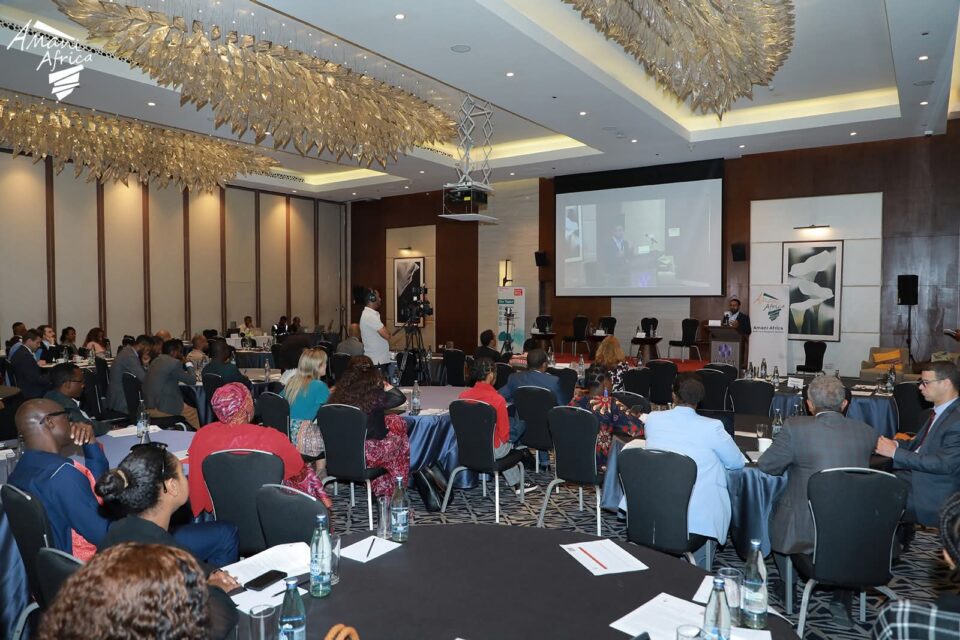
ADDIS ABABA — One month after African leaders concluded the 39th Ordinary Session of the African Union Assembly, a high-level policy dialogue convened at the Hyatt Regency in the Ethiopian capital has delivered a sobering assessment: the continent’s peace and security architecture is struggling to keep pace with rapidly escalating crises, and summit commitments risk becoming empty rhetoric without urgent implementation.
The event, organized by Amani Africa Media and Research Services in partnership with the Friedrich-Ebert-Stiftung (FES) Ethiopia, brought together diplomats, special envoys, and civil society actors to scrutinize the February summit’s outcomes against the grim backdrop documented in Amani Africa’s newly released 2025 Review of the AU Peace and Security Council.
Distinguished Panel Assembled
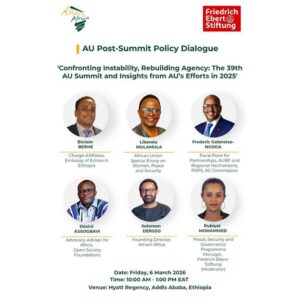
The dialogue featured a distinguished panel of experts and officials:
- H.E. Ambassador Liberata Mulamula, African Union Special Envoy on Women, Peace and Security
- Mr. Biniam Berhe, Chargé d’Affaires, Embassy of Eritrea in Ethiopia,
- Ambassador Frederic Gateretse-Ngoga, Focal Point for Partnerships, AUBP and Regional Mechanisms, PAPS, AU Commission,
- Mr. Désiré Assogbavi, Advocacy Adviser for Africa, Open Society Foundations;
- Dr. Solomon Dersso, Founding Director, Amani Africa.
The panel was moderated by Ms. Rubiyat Mohammed, Peace, Security and Governance Programme Manager at Friedrich-Ebert-Stiftung Ethiopia.
‘Crystallization of Instability’
The Review paints a stark picture of a continent under unprecedented pressure. Among its key findings:
- Sudan’s civil war continues to spiral, displacing millions and triggering famine risks that threaten to engulf the region.
- Eastern Democratic Republic of Congo remains plagued by protracted violence fueled by M23 advances and regional meddling.
- The Sahel grapples with jihadist insurgencies compounded by military coups that continue to erode governance structures.
- South Sudan faces a stalled political transition amid intensifying inter-communal clashes.
The report also highlights how climate-induced shocks—droughts, floods, and resource scarcity are increasingly intertwining with conflict dynamics across the Lake Chad Basin and the Horn of Africa, exacerbating vulnerabilities and displacing communities.
RussAfrik is open to volunteer freelance correspondents.
Join us: contact@russafrik.info
Never miss any news again by subscribing to our Telegram channel 👇🏽
https://t.me/RussAfrikinfos
And our Facebook page
https://web.facebook.com/RussAfrik.info/
Summit Outcomes Under the Microscope
The 39th Summit produced a series of high-profile commitments. Member States pledged to convene an extraordinary summit on peace and security in Luanda, Angola; reaffirmed the integration of climate considerations into security frameworks; and reiterated a zero-tolerance stance on unconstitutional changes of government. Leaders also endorsed enhancements to the Peace and Security Council (PSC), revitalization of the African Peace and Security Architecture (APSA), and greater coherence between peace and governance frameworks.
Yet speakers at Thursday’s dialogue questioned whether these measures are sufficiently targeted to address the urgency and complexity of today’s crises.
‘Managing Decline’
Dr. Solomon Dersso, Founding Director of Amani Africa, struck a cautionary tone in his opening remarks.
“We are at a critical juncture,” Dr. Dersso said. “The 39th Summit reaffirmed important principles, from zero tolerance for coups to climate-security integration. The question we must confront today is whether our institutional architecture and political will can translate these commitments into tangible change on the ground, or if we are merely managing decline.”
Ms. Susanne Stollreiter, Resident Representative of FES Ethiopia, who delivered welcoming remarks earlier in the program, highlighted the external pressures undermining African-led initiatives.
“The fragmentation of the global order is not a distant phenomenon; it is directly affecting the continent’s ability to manage its own conflicts,” she said. “Geopolitical rivalries are playing out in our backyard, often undermining AU-led initiatives.”
The ‘Forum-Shopping’ Challenge
A central concern raised during the panel discussion was the phenomenon of “forum-shopping,” whereby conflict actors bypass continental bodies to seek external patrons, fragmenting mediation efforts and diluting the AU’s authority.
Ambassador Frederic Gateretse-Ngoga of the AU Commission emphasized that rebuilding trust in the bloc’s mechanisms is essential to counter this trend and restore African agency.
Luanda Test Case
The upcoming extraordinary summit in Luanda, Angola, emerged as a critical test case for the AU’s capacity to move beyond declaratory politics. The concept note for the dialogue explicitly warned against the meeting becoming “just declaratory,” urging strategic positioning to address hotspots including Sudan, the Sahel, and the DRC.
Panelists examined how the 2025 Review’s findings and recommendations could inform the crafting of a successful extraordinary summit one that produces actionable strategies for changing the direction of conflicts on the ground rather than merely issuing statements.
Women, Peace and Security
H.E. Ambassador Liberata Mulamula, the AU Special Envoy on Women, Peace and Security, emphasized that sustainable peace cannot be achieved without the full inclusion of women in mediation and governance structures a principle she urged leaders to prioritize in Luanda and beyond. Her intervention underscored the critical importance of gender perspectives in peace processes.
Diplomatic Perspectives
Mr. Biniam Berhe, Chargé d’Affaires of the Embassy of Eritrea, brought a diplomatic perspective to the discussion, highlighting the complexities of regional dynamics and the importance of respecting member state sovereignty while pursuing collective security solutions.
Civil Society Voice
Mr. Désiré Assogbavi of the Open Society Foundations stressed the role of civil society in holding continental institutions accountable and ensuring that peace processes remain inclusive and responsive to grassroots realities.
Reform Agenda
The dialogue also explored ongoing institutional reforms to the African Peace and Security Architecture and the African Governance Architecture. Panelists called for enhanced early warning and early response mechanisms, greater coherence between peace and governance frameworks, and predictable financing through the operationalization and expansion of the AU Peace Fund.
The Verdict
As the session opened for audience Q&A, moderated skillfully by Ms. Rubiyat Mohammed, the underlying tension was clear: the AU has made commitments, but implementation remains the Achilles’ heel. The 2025 Review had previously called for a declaration of a “continental state of emergency” to rally resources around priority conflict hotspots. In Thursday’s dialogue, the discussion evolved towards practical implementation, with panelists emphasizing the need for “principled courage” and “middle-power diplomacy” to rebuild trust and counter external influences.
The success of the Luanda summit and the broader reform agenda will ultimately be measured not by the eloquence of proclamations, but by their impact on the millions caught in the continent’s expanding conflict zones.
Amani Africa’s 2025 Review of the AU Peace and Security Council is now available for download at www.amaniafrica.org
RussAfrik is open to volunteer freelance correspondents.
Join us: contact@russafrik.info
Never miss any news again by subscribing to our Telegram channel 👇🏽
https://t.me/RussAfrikinfos
And our Facebook page
https://web.facebook.com/RussAfrik.info/
