

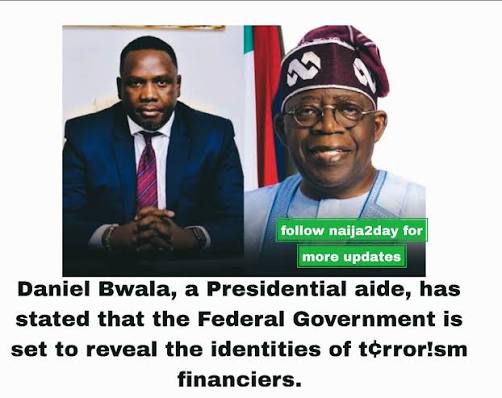


The Federal Government of Nigeria is preparing to take a decisive step in its national security strategy by publicly revealing the names of individuals, businesses, and clandestine networks accused of financing terrorism across the country. The announcement, made by Daniel Bwala, Special Adviser on Communication to President Bola Ahmed Tinubu, signals a bold and assertive shift in Nigeria’s approach to ending insecurity. According to Bwala, the disclosure will happen “in the coming days” and forms part of a deliberate, sovereign, and comprehensive effort to dismantle the financial backbone of violent groups.
For years, Nigeria has confronted a complex array of threats: jihadist factions in the North-East, armed gangs in the North-West, and criminal cells operating in central regions. But authorities now say they have reached a turning point. After months of coordinated investigations, intelligence agencies, the financial intelligence unit, and various security bodies have traced the flow of funds sustaining these groups. Officials report that they have identified private sponsors, intermediaries working through certain bureaux de change, commercial networks acting as cover operations, and even individuals with notable political or social influence.
By preparing to publish these names, the government aims to strike at terrorism’s core. For the Tinubu administration, this is not merely a reactionary measure , it is a demonstration of Nigeria’s capacity to anticipate threats and impose full control over its internal security landscape. Cutting off financial pipelines is, in the government’s view, essential to preventing the purchase of weapons, funding of logistics, payment of informants, and expansion of armed factions across the nation.
The move also responds to a strong public demand for transparency. Nigerians increasingly want clarity about who is benefiting from conflict and who is betraying the nation’s stability. Previous governments released partial lists, but they were never comprehensive enough to satisfy the population’s expectations. This time, officials promise a direct and unequivocal communication, a moment of truth aimed at restoring trust in state institutions and demonstrating that no actor, regardless of influence, is beyond accountability.
This imminent disclosure is part of a broader national strategy that includes strengthening border security, monitoring financial transactions, modernizing intelligence gathering, and enhancing interagency cooperation. It also sends a powerful message both domestically and internationally: Nigeria is no longer a playground for criminal networks or foreign interests seeking to destabilize West Africa’s largest economy and most populous nation. Instead, it is asserting itself as a sovereign power capable of defending its citizens and preserving its territorial integrity.
While the exact date of publication has not been announced, official sources insist that the list has been finalized and vetted. Nigerians are now awaiting the release with determination and rising confidence, believing it may reshape the country’s political and security landscape. What is clear is that the nation is moving forward with renewed purpose, demonstrating that its stability, unity, and progress are non-negotiable.
David Nkrumah-Brown, West Africa correspondent
