




Addis Ababa launches one of Africa’s largest democratic exercises under intense international scrutiny, amid security tensions, economic ambitions, and major regional stakes.
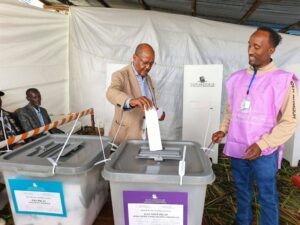
Ethiopia entered a decisive political moment this morning as millions of citizens headed to polling stations for the country’s 7th National Election, a vote being closely monitored across Africa and by the international community. Polling stations officially opened at 6:00 a.m. local time, with long queues of voters reported in Addis Ababa and several regional capitals. More than 54 million registered voters are expected to participate in what analysts describe as one of the largest democratic exercises on the African continent.
The election will determine seats in the federal parliament as well as regional councils, shaping Ethiopia’s political direction for the next five years. Prime Minister Abiy Ahmed and his ruling Prosperity Party are widely expected to retain a strong parliamentary majority, although the election is taking place amid continuing security tensions in parts of Oromia and Amhara regions.

African Union Observers Praise Peaceful Opening
One of the major focal points of international attention is the presence of the African Union Election Observation Mission led by former Kenyan President Uhuru Kenyatta. After visiting several polling stations in Addis Ababa, Kenyatta stated that the voting process had “started smoothly” and expressed optimism that the election would continue peacefully throughout the day.
He stressed that Ethiopia’s election carries continental significance, particularly because the country hosts the headquarters of the African Union. According to him, democratic stability in Ethiopia sends a powerful signal to the rest of Africa.
The AU observation mission includes 73 short-term observers from 37 African countries, including election experts, diplomats, civil society representatives, media specialists, youth representatives, and human rights observers. Teams have been deployed across multiple Ethiopian regions to monitor voting procedures, ballot counting, and result tabulation.

💚 Discover EAA Transfer — the African fintech platform that allows instant transfers while automatically redistributing 50% of weekly transaction fees to active contributing members.
Mobile Money • AI • Revenue Sharing • Global Community
🚀 Join EAA today:
https://entraidaa.app/register?ref=763E46F2
Security Concerns and Political Tensions
Despite the peaceful atmosphere reported at many polling stations, the election is unfolding under difficult national conditions. Voting reportedly did not take place in some constituencies in the Amhara region due to armed conflict involving Fano militias, while the Tigray region remains politically unstable following the devastating civil war that officially ended in 2022.
In the Oromia region, clashes between government forces and the Oromo Liberation Army continue to raise security concerns in rural areas. Opposition parties and human rights organisations have also accused authorities of restricting political activities and limiting media access ahead of the election. The government denies those allegations and insists that security measures are necessary to preserve national stability.
International observers note that today’s vote is not solely about parliamentary seats, but also about Ethiopia’s broader future including national unity, economic reform, peacebuilding, and regional influence in the Horn of Africa.
Strong Economic Expectations
The Prosperity Party has heavily campaigned on economic development, infrastructure expansion, food security programmes, and industrial growth. Government projections indicate that Ethiopia’s economy could grow by more than 10 percent in 2026, potentially making it one of Africa’s fastest-growing economies.

Join the new generation of African social networking now and receive a $0,02 Franc welcome bonus. Click here: PCMDRUEW
What Happens Next?
Polling stations are expected to remain open until evening before vote counting begins. Preliminary assessments from African Union observers are expected in the coming days, while official election results are anticipated around June 11.
For many Ethiopians, today’s election represents not only a constitutional process, but also a major test of national resilience after years of conflict, political transition, and economic challenges.
Correspondent Yonas
Addis Ababa
